
Immigration
Useful Info
About Asylum
Source: LawHelpNY
Asylum protects people who are afraid to go back to their home country because they were harmed or threatened because of their race, religion, nationality, political beliefs, or membership in a group. If you left your home country to escape this kind of harm, and if the harm or threats came from your government, military, or other group, and the government did not keep you safe, you may qualify for asylum.
Examples of people who can apply for asylum if they are harmed or threatened include:
A reformer or activist
A woman who is against genital cutting
A family member of an elected or political leader
A member of a religious minority
A woman who is the victim of domestic violence in a country that does not protect women
A member of a clan or race targeted by another clan or race
A person who is against forced sterilization
A person who identifies as lesbian, gay, bisexual, and/or transgender
Asylum applicants can apply for their spouses and unmarried children under 21. After 1 year of asylum, they can apply for a green card.
Other rules about asylum
Each asylum case is different. It can be hard to prove when it is safe or not to live in a home country or a different part of a home country. And if an applicant waits a year or more, it is harder to qualify. It's helpful to talk to a Legal Advocate to see if you qualify for asylum. If not, you may qualify for another protection, like withholding or the Convention Against Torture.
Eligibility Requirements
You may qualify for asylum if:
You were harmed in the past, or are afraid you will be harmed in the future because of your race, religion, nationality, political beliefs, or membership in a group.
Your government caused the problem or will not protect you.
You have no other safe place to live.
You have not committed a serious crime or harmed someone else.
Note: It is harder to qualify for asylum after you have lived in the U.S. for more than one year.
Tips for filling out the asylum forms
Check the rules and risks to decide if you should apply.
Understand how to explain your case to show how you qualify.
Only sign a form if you agree with everything written on it. The USCIS (government agency) and Immigration Courts deny cases that have wrong information or lies. Bad applications disqualify you from other immigration benefits too.
Get legal help if you don't understand the rules and forms: www.immigrationlawhelp.org
(source: https://www.lawhelpny.org)
Useful Info
How do I get a Social Security number?
Resource | LawHelpNY
Social Security Numbers for Noncitizens
Social Security numbers (SSNs) are for reporting your wages to the government and tracking your Social Security benefits. Generally, you must have permission to work in the United States to get an SSN.
If you have a legal immigration status that allows you to work, contact your local Social Security office to apply for a number. You need to prove your identity, age, and work-authorized immigration status. Find an office near you: https://www.ssa.gov/locator/
Many companies, such as banks and credit companies, may ask for your SSN. You don't have to provide one if you don’t have one. Warning: using a fake SSN can hurt your immigration case.
If you don't have permission to work in the US
You can apply for an Individual Taxpayer Identification Number from the Internal Revenue Service (IRS). Visit the IRS in person, or call the IRS toll-free number, 1-800-TAXFORM (1-800-829-3676), and ask for the "Form W-7, Application for IRS Individual Taxpayer Identification Number."
(source: https://www.lawhelpny.org)
Useful Info
Know Your Rights
Immigrants & NY
NYIC partnered with the Center for Urban Pedagogy (CUP) and designer Luiza Dale to create Immigrants & NY, a fold-out poster in English, Spanish, and French. The illustrated poster guides immigrants in New York State on how to avoid immigration scams, protect their families when interacting with ICE, and create a plan for their family in the event of deportation.
Our partnership continued with Immigrants & Upstate NY, a companion piece that focuses on the upstate regional context. The tri-fold poster educates immigrants on how to interact with Border Patrol and local law enforcement, and ways to reduce the risk from traffic stops.
Resources for Immigrants
Know Your Rights
Immigrants & NY
All immigrants have rights in New York—regardless of your status. This guide will help you understand your rights, where to get help, and what to do when interacting with ICE.
Community members and allies should be aware of their rights whenever dealing with Immigration and Customs Enforcement (ICE), Border Patrol, or other law enforcement.
If you are stopped by immigration or other law
enforcement, remember:
- Stay calm. Do not run. Do not resist or
- obstruct the officer.
- Do not lie or provide false documents.
- You have the right to remain silent. Anything
- you say can be used against you.
- If an agent asks if they can search you or
- your belongings, you have the right to say no.
- However, you may not physically resist.
- Police may pat down your clothing if they
- suspect a weapon.
- If you are not a US citizen and an immigration
- agent requests your immigration papers, you
- must show them if you have them with you.
- If you are stopped, detained, or harassed by
- law enforcement, try to get the agent(s)’
- name, number, and any other identifying
- information.
- You or someone else in the community can
- take video or audio recordings of interactions
- with law enforcement. You can also write
- down what happened after they leave.
- It is illegal for law enforcement officers to
- perform any stops, searches, detentions, or
- deportations based on your race, national
- origin, religion, sex, or ethnicity.
You can report interactions with federal agents to the Immigrant Defense Project (IDP).
Private Spaces
Your home and other “private spaces” (such as employee-only areas of a workplace) carry special protections that public spaces do not.
Officers can only enter private spaces if they have your consent or they show you a judicial warrant (signed by a judge).
Protected Areas
- In January 2025, the Trump administration cancelled a longstanding policy that directs ICE and CBP to avoid immigration enforcement in “sensitive locations” or “protected areas” such as schools, healthcare facilities, and places of worship.
- Despite these changes, New Yorkers still have some protections in these locations.
- A 2018 New York State Executive Order prohibits immigration enforcement at New York state facilities such as a public school or hospital unless ICE has a judicial warrant.
- The Protect Our Courts Act protects New Yorkers from arrest at state, city, and municipal courts without a judicial warrant.
- ICE and other agents cannot enter “private spaces” without a judicial warrant or consent of the owner.
Be aware of immigration fraud
Immigration law is complicated. Be careful when
discussing your situation with any person or business.
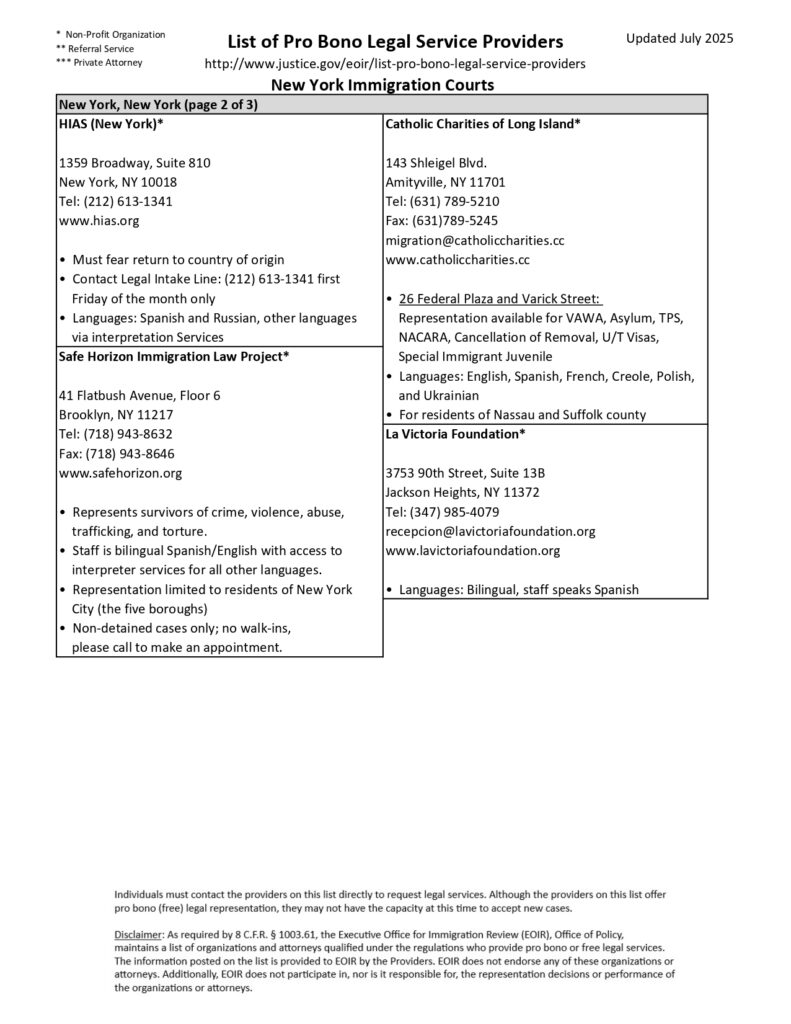
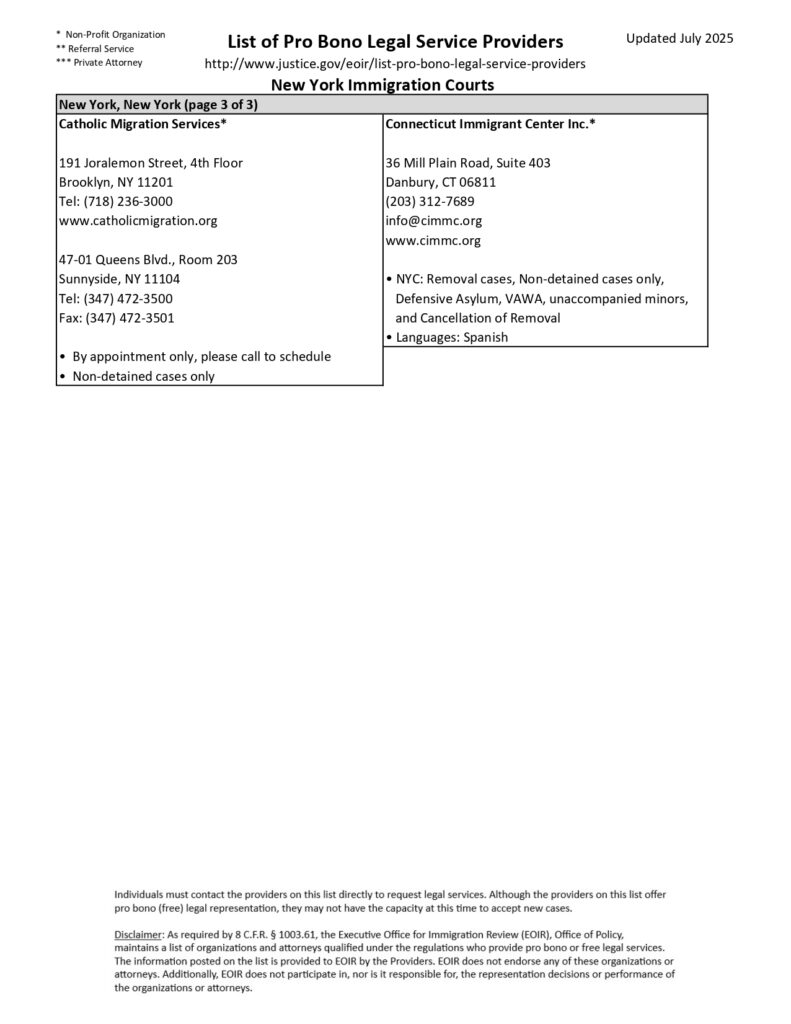
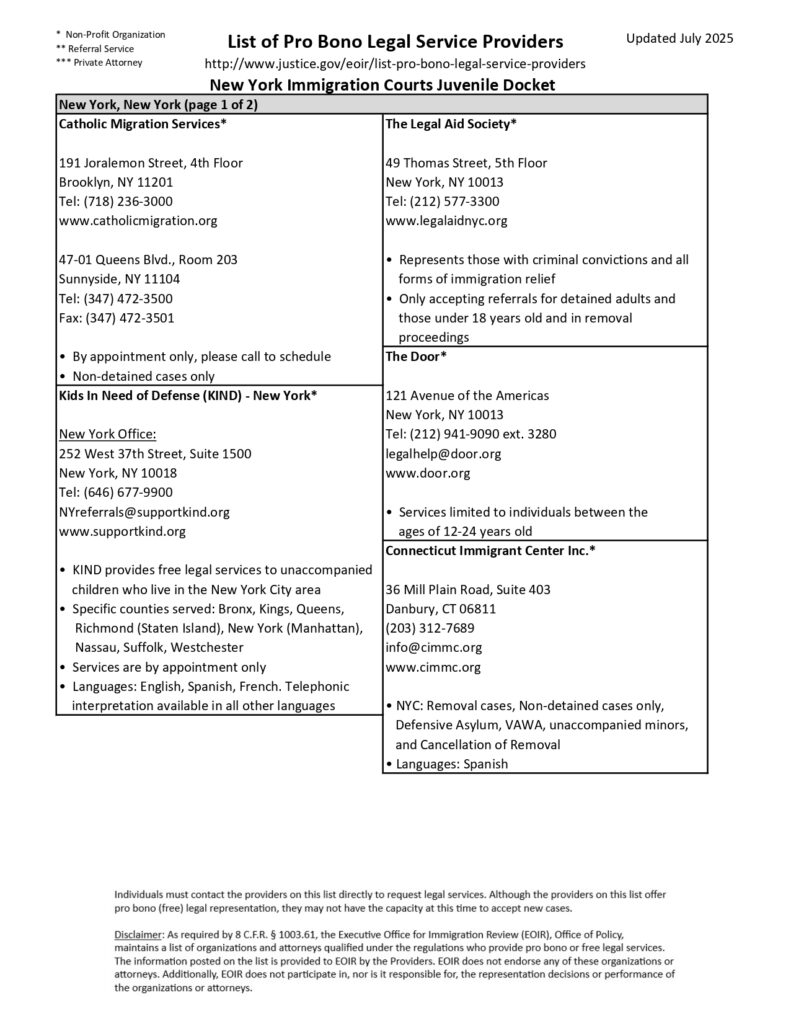
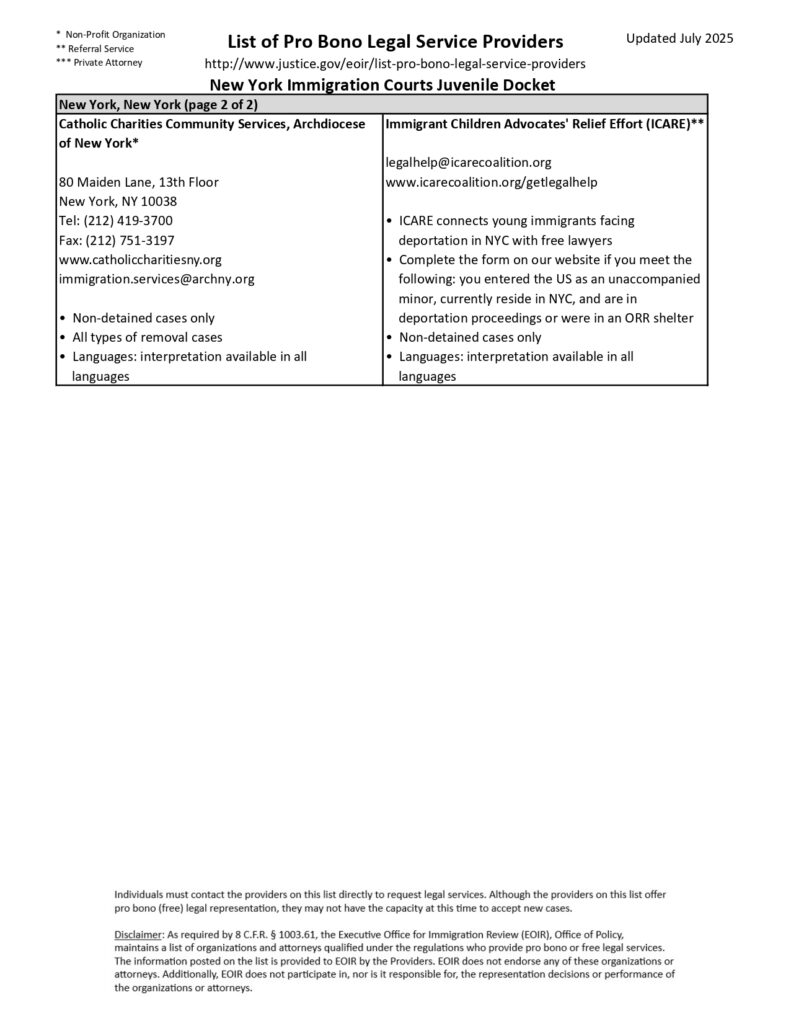
You should only speak to a lawyer or Department of Justice (DOJ) accredited representative for legal advice on your situation.
Never get immigration help from a “notario,” travel agent, tax preparer, forms preparer, or notary. In the US, a “notario” is NOT a lawyer!
If you need help with your case or have general immigration questions, call the Office for New Americans hotline at 1-800-566-7636.
Immigration Enforcement at the Workplace
Immigration Enforcement at the Workplace
This guide will explain what immigration enforcement is, what to do if they come to your workplace, and how to be prepared in case of a raid.
What is ICE?
- ICE is the acronym for Immigration and Customs Enforcement, a federal agency under the Department of Homeland Security (DHS) that enforces immigration law.
- ICE agents are federal agents, and are not the same as local police. Their uniforms may say “Police,” “Federal Agent,” “ICE,” or “HSI.” They may also not be in uniform. They may carry guns. Sometimes local police officers go with ICE agents on ICE raids.
What does ICE do at workplaces?
- Immigration agents may come to your workplace for a Form I-9 audit; a raid; or to detain specific people.
- With an ICE raid, the employer has no warning. With audits, there is often a subpoena beforehand. An ICE audit is “friendlier” than a raid but can also lead to damaging results.
Asylum
Immigration Paperwork and Related Questions
Change of Address
If you move, it is important that you update your address with the U.S. government.
Removal Orders
What is a Removal Order?
A removal order (formerly called a "deportation order") is issued when a U.S. court decides that a person is not legally allowed to stay in the United States. This can happen for different reasons, such as:
- Entering the U.S. without proper documents or a visa
- Overstaying a visa
- Committing certain crimes
- Violating immigration rules
Medicaid and Child Health Coverage
Medicaid and Child Health Plus Postpartum Coverage Extended from 60 Days to One Year
Book an appointment
1 hr | $95
A meeting with an intake specialist for a immigration case evaluation.
